Dronamics: the Black Swan and the case for cargo drone express freight between cities
Dronamics was founded in Sofia, Bulgaria in 2014 by brothers Svilen and Konstantin Rangelov. The founding story is somewhat atypical for a deep-tech startup: two brothers with backgrounds outside aviation who identified a logistics gap — same-day cargo delivery between cities at costs that conventional aviation cannot achieve — and set out to build an unmanned aircraft designed specifically for it.
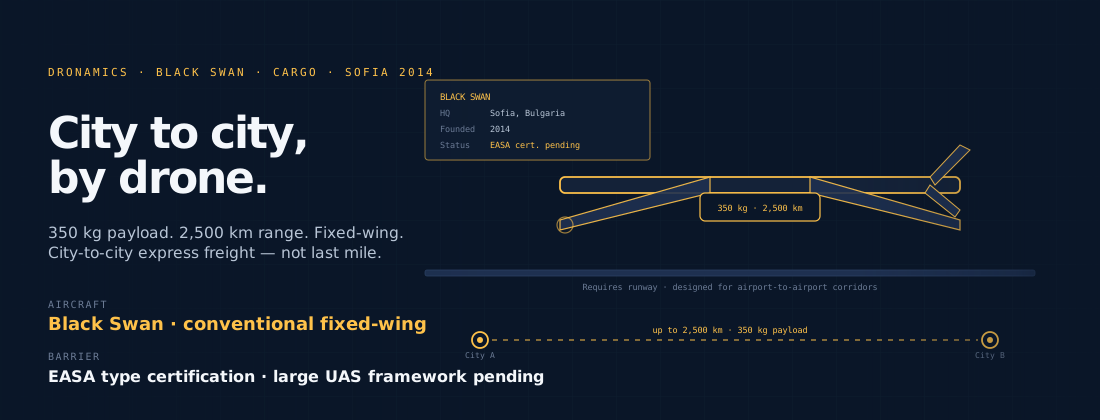
The company has spent the decade since its founding developing the Black Swan, a fixed-wing unmanned cargo aircraft whose specifications — up to 350 kilograms of payload, up to 2,500 kilometres of range — place it in a category that has no direct operational equivalent among current commercial unmanned aircraft. The Black Swan is not a delivery drone in the sense that Wing’s or Zipline’s aircraft are delivery drones. It is closer to an unmanned version of a small cargo aircraft, designed for the same point-to-point freight corridors that turboprop aircraft currently serve.
The Black Swan aircraft
The Black Swan uses a conventional fixed-wing configuration — not VTOL — which means it requires a runway for take-off and landing. This is a fundamental design choice that reflects a specific market thesis: that the logistics corridors the Black Swan will serve are between airports or airstrips, not between arbitrary locations. The aircraft is designed to operate from smaller regional airports and airstrips that do not require the infrastructure of major commercial aviation facilities, expanding the range of origin-destination pairs that the service can connect.
The aircraft’s fuel efficiency — a key design priority given the range specification — is achieved through conventional fixed-wing aerodynamics that cannot be matched by multirotor or VTOL configurations at the cargo scale the Black Swan is designed for. The trade-off, compared to a VTOL design, is the infrastructure requirement for take-off and landing — but for a cargo drone operating between logistics hub airports, that trade-off is acceptable in a way that it would not be for a residential delivery application.
The market Dronamics is targeting
The logistics market that Dronamics describes as its target is freight that currently moves by road courier or small air charter between regional cities — typically 100 to 500 kilometres apart — where the cost and speed of available options are both suboptimal. A two-hour flight by autonomous cargo drone between regional airports could replace a four to six-hour road journey at lower cost, or provide a more affordable alternative to small aircraft charter that is currently reserved for the highest-value time-critical freight.
The company has described its intended business model as operating its own cargo drone network between European cities, using a hub-and-spoke model with regional airports as nodes. The European geography — numerous medium-sized cities within the 200 to 1,000 kilometre range that suits the Black Swan’s operating profile — makes it a logical initial market for the service Dronamics describes.
The certification challenge and timeline
The Black Swan’s payload and size put it in a regulatory category that requires type certification from aviation authorities — EASA in Europe — rather than the operational authorisation pathway available to smaller delivery drones. EASA’s type certification process for large unmanned aircraft is still being developed, and the absence of an established certification pathway is the primary constraint on the Black Swan’s path to commercial operations.
Dronamics has engaged with EASA and has participated in the regulatory development process for large unmanned cargo aircraft. The company’s position — as one of the few European companies developing an aircraft in this specific category, at this stage of development — gives it a degree of influence in the regulatory development process that later entrants to the category would not have. The company has publicly discussed plans for commercial service launch in European markets, though the timeline depends substantially on the pace of EASA type certification framework development for this class of aircraft.
The broader cargo drone landscape
Dronamics occupies a specific niche within the broader cargo drone development space. Elroy Air’s Chaparral targets middle-mile distribution centre to hub transport at shorter range and smaller payload. Dronamics targets city-to-city express freight at longer range and larger payload. The two niches are complementary rather than competitive — different points on the cargo drone spectrum addressing different logistics problems. Together with the parcel-scale delivery drones that have already reached commercial scale, they represent a layered cargo drone ecosystem that, if each segment succeeds, could substantially change the cost structure of time-sensitive freight logistics.